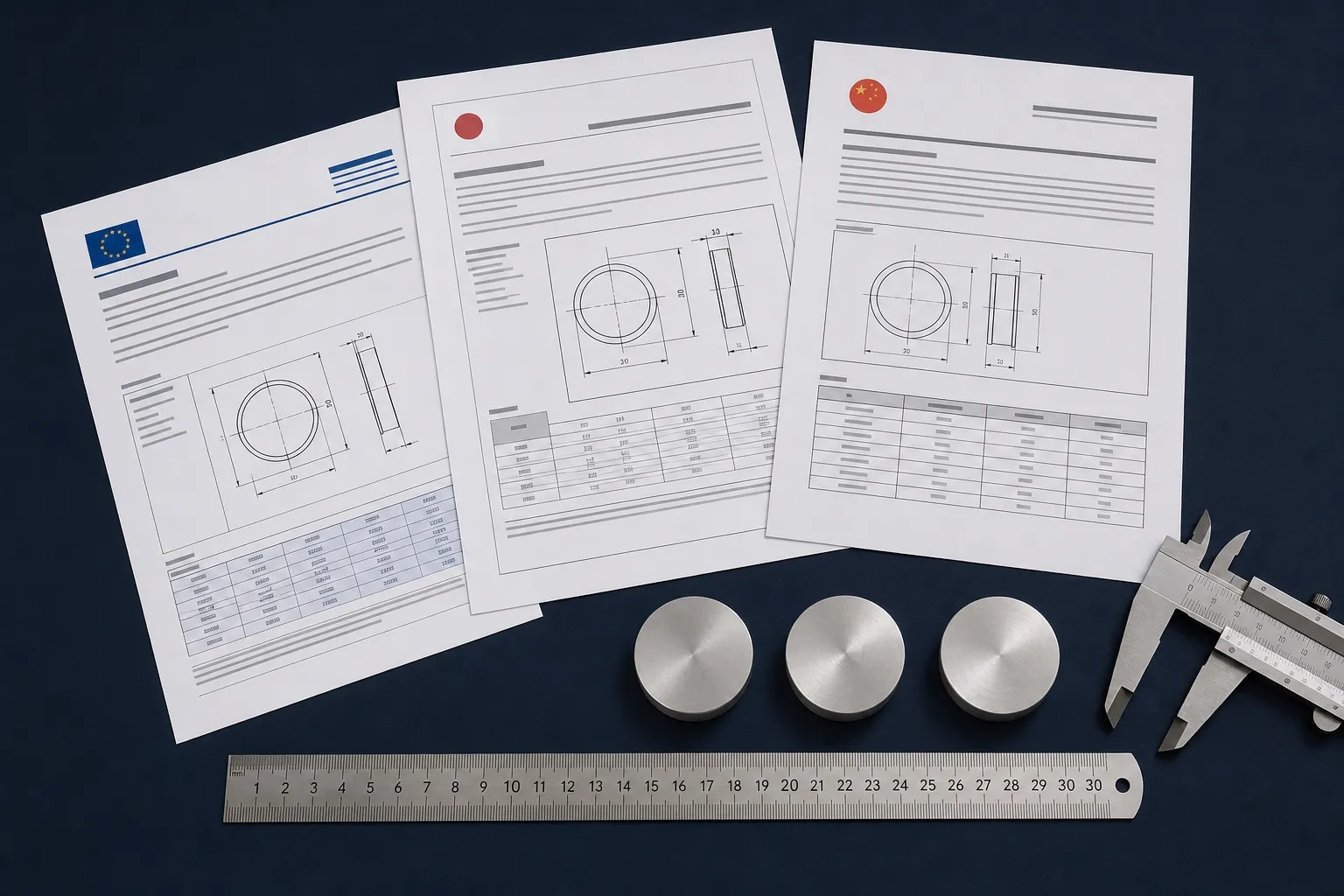
Three designations get quoted against each other in the same breath: ADC12, A380 and A383. Buyers treat them as regional names for one alloy and ask for whichever their customer wrote on the drawing. Two of them are close. One of them is not, and specifying it by accident changes both the copper content and the way the casting machines.
Where the three designations come from
ADC12 is Japanese, from JIS H 5302. A380 and A383 are American, both from ASTM B85. The European equivalent that matters to a foundry buying in the EU is EN AC-46000, chemical designation AlSi9Cu3(Fe), from EN 1706. Four names, three genuinely different chemistries.
The composition, side by side
| Element | ADC12 / EN AC-46000 | A383 | A380 |
|---|---|---|---|
| Silicon (Si) | 9.6–12.0 | 9.5–11.5 | 7.5–9.5 |
| Copper (Cu) | 1.5–3.5 | 2.0–3.0 | 3.0–4.0 |
| Iron (Fe) max | 1.3 | 1.3 | 1.3 |
| Zinc (Zn) max | 1.2 | 3.0 | 3.0 |
| Magnesium (Mg) max | 0.3 | 0.10 | 0.10 |
Read the silicon and copper rows together and the picture resolves. ADC12 and A383 overlap across most of their range. A380 sits somewhere else: two points lower on silicon, a full point higher on copper.
What that difference does on the shop floor
Silicon governs how the metal fills the die. More silicon means more fluidity, which is what lets you cast a 2 mm wall across a long flow path before the metal freezes. ADC12 at 9.6 to 12% fills thin sections that A380 at 7.5 to 9.5% will struggle with. If you switch a thin-wall part from ADC12 to A380 without changing anything else, misruns and cold shuts are the first thing you will see.
Copper governs strength, machinability and what happens in a corrosive environment. A380's higher copper gives slightly better strength and cleaner machining. It also worsens corrosion resistance, which matters on any part that will live in a wheel arch or under a bonnet without a coating.
If your drawing says A380 and your part has thin walls, the drawing is probably inherited from a North American design that assumed a different casting envelope. Check it before you buy the metal.
Which one should a European foundry actually buy?
Buy to EN AC-46000. It is the specification your European customers will audit against, it is what your quality system is built around, and it covers the same chemistry as ADC12. Treating ADC12 and EN AC-46000 as one purchase is correct.
The complication arrives when a North American customer specifies A383 or A380 on a part you cast in Europe. In that case you have two options. Either qualify a second alloy, with the second vendor file and second incoming inspection that implies. Or ask your supplier to certify the heat to the tighter of the two specifications so a single delivery satisfies both approvals.
Certifying ADC12 to A383 limits
A383 is the closer of the two American grades and the practical one to align with. Its copper band, 2.0 to 3.0%, sits inside the ADC12 band of 1.5 to 3.5%, and its silicon band sits inside ADC12's as well. A heat cast to hit the middle of the ADC12 range will usually satisfy A383 on its own.
The element that catches people out is zinc. A383 permits up to 3.0%, ADC12 up to 1.2%. That is the opposite of a problem, because ADC12's tighter limit is the harder one to meet. If your supplier can certify ADC12 zinc, A383 zinc is already covered.
We tighten the heat composition and certify to whichever standard the specification requires, on the same material test certificate, at no additional cost on standard-tonnage orders. If your downstream customer needs A383 compliance, put it on the enquiry.
A380 is a different alloy, not a different name
The point worth carrying away: ADC12 and A383 are close enough to treat as one purchasing decision with the right certification. A380, with its lower silicon and higher copper, is a separate alloy that behaves differently in the die and in service. Substituting it because the names look interchangeable is how a qualified part starts failing at the tail of a production run.
Sourcing ADC12 into Europe? Our ingots are certified to EN AC-46000 and JIS H 5302 on a single material test certificate, with A383 certification on request and CBAM emissions documentation on every shipment. See the full ADC12 specification.