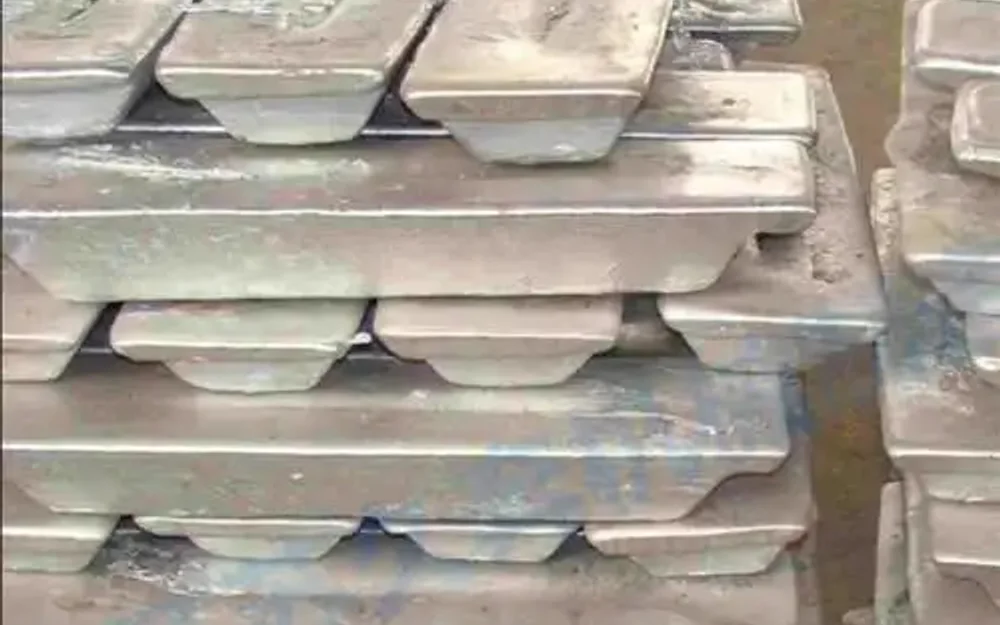
ADC12 Die-Casting Aluminium Alloy Ingot
The industry-standard die-casting alloy for thin-walled, complex castings at scale. Excellent fluidity, stable mechanical properties, low shrinkage — the workhorse of European foundries and automotive die-casters.
Overview
You already know what ADC12 is. Here is what is different about buying it from us.
About the alloy
ADC12 is the most widely traded die-casting aluminium alloy in the world. Under the European EN 1706 standard it is designated EN AC-46000 (chemical designation AlSi9Cu3(Fe)), and under the Japanese JIS H 5302 standard it is simply ADC12. Both designations describe a near-identical aluminium-silicon-copper composition, with 9.6 to 12% silicon and 1.5 to 3.5% copper, optimised for high-pressure die casting.
For European foundries and automotive die-casters it is the default working alloy for thin-walled, high-volume castings. It combines the fluidity needed to fill complex dies at speed, low shrinkage during solidification, good hot-cracking resistance, and stable mechanical properties in the as-cast condition. We manufacture it in our 50,000 m² Egyptian facility and ship on a 10 to 30 day lead time to Rotterdam, Hamburg and Genoa.
Specifications
General properties
| Designation | ADC12 / EN AC-46000 / AlSi9Cu3(Fe) |
| Standard ingot weight | 20 kg ± 0.5 kg |
| Bundle weight | 500–1,000 kg (configurable) |
| Density | ≈ 2.74 g/cm³ |
| Melting range | 540–595 °C |
| Surface condition | Clean, free from slag and dross |
| Marking | Heat number, alloy grade and weight stamped per ingot |
| Tonnes per 20ft container | ~20–22 t |
| Tonnes per 40ft container | ~24–26 t |
Chemical composition (EN AC-46000)
| Element | Min % | Max % |
|---|---|---|
| Silicon (Si) | 9.6 | 12.0 |
| Iron (Fe) | — | 1.3 |
| Copper (Cu) | 1.5 | 3.5 |
| Manganese (Mn) | — | 0.5 |
| Magnesium (Mg) | — | 0.3 |
| Nickel (Ni) | — | 0.5 |
| Zinc (Zn) | — | 1.2 |
| Tin (Sn) | — | 0.3 |
| Lead (Pb) | — | 0.2 |
| Titanium (Ti) | — | 0.2 |
| Aluminium (Al) | Balance | |
Mechanical properties (typical, as-cast)
| Property | Typical value |
|---|---|
| Tensile strength (Rm) | 240–310 MPa |
| 0.2% proof stress (Rp0.2) | 140–170 MPa |
| Elongation (A) | 1–3 % |
| Brinell hardness (HB) | 80–110 |
| Modulus of elasticity | ~71 GPa |
| Thermal conductivity | ~92 W/(m·K) |
Casting characteristics
- Fluidity: Excellent — ideal for thin-walled, complex geometries
- Shrinkage: Low — dimensional stability across the casting
- Hot-cracking resistance: Good — tolerant of complex mould designs
- Pressure tightness: Good — suitable for housings and enclosures
- Machinability: Good in the as-cast condition
- Corrosion resistance: Moderate — typically protected by coating
Standards & equivalents
European buyers purchasing to EN nomenclature can reference the exact equivalents across Japanese, Chinese and American standards below. Tech Aluminum certifies each shipment to whichever standard your specification requires.
| Region | Standard | Designation |
|---|---|---|
| Europe (EU) | EN 1706 | EN AC-46000 / AlSi9Cu3(Fe) |
| Germany | DIN EN 1706 | AlSi9Cu3(Fe) — DIN nomenclature aligned with EN |
| Japan | JIS H 5302 | ADC12 |
| USA | ANSI / AA | A383 (closest equivalent) |
| China | GB/T 15115 | YL113 (functional equivalent) |
| ISO | ISO 3522 | Al-Si9Cu3Fe |
A383 is the closest North American equivalent but has tighter limits on iron and zinc than ADC12 / EN AC-46000. If your downstream customer specifies A383 compliance, please mention it on your enquiry and we will certify the heat to meet A383 limits.
Applications
ADC12 is the default working alloy for the European die-casting industry across seven major end-markets. Typical components include:
For application-specific guidance, see our Automotive industry page or Mechanical Manufacturing page.
Quality & testing
Every ADC12 heat undergoes full optical emission spectrometry (OES) verification before casting. Our quality regime is built on ISO 9001-certified processes and is structured to meet European automotive-sector expectations.
- Spectro analysis (OES) on every heat — full chemical composition verification against EN AC-46000 limits
- Material Test Certificate (MTC) issued per shipment to EN 10204 3.1 standard
- SGS third-party inspection available on buyer request (pre-shipment or load-port)
- Heat traceability — every ingot stamped with heat number for full traceability back to raw materials
- Mechanical testing — tensile, yield, elongation and hardness samples available on request
- Microstructure analysis — available for first-article approval and ongoing process audits
View our full Quality & Compliance page for ISO 9001 certification details, REACH compliance documentation and our testing & inspection capabilities.
CBAM compliance documentation
The EU Carbon Border Adjustment Mechanism entered its definitive phase on 1 January 2026. Aluminium imports are explicitly covered. Every ADC12 shipment from Tech Aluminum includes the verified emissions documentation your CBAM declaration requires:
- Embedded emissions per tonne — direct (Scope 1) and indirect (Scope 2) emissions
- Production-method documentation — energy source, smelting process, electricity grid mix
- Third-party verification by an accredited body, formatted to EU CBAM methodology
- Quarterly carbon-footprint reports for ongoing buyers — supports your CBAM declarations.
Egypt's aluminium industry draws on hydroelectric power from the Aswan High Dam, and the country is commissioning 1 GW of additional green power specifically for aluminium manufacturing. Lower embedded emissions mean fewer CBAM certificates your business needs to purchase. Read our full CBAM guide →
Packaging & shipping
ADC12 ingots are bundled with high-tensile steel straps, palletised for container loading, and shrink-wrapped where required. Standard bundle weights are configurable between 500 kg and 1,000 kg to match your handling equipment.
- 20ft container: ~20–22 tonnes net (typical load)
- 40ft container: ~24–26 tonnes net (heavy-load configuration)
- European ports served: Rotterdam, Hamburg, Antwerp, Genoa, Barcelona, Felixstowe
- Incoterms offered: FOB Egyptian port, CIF named EU port, CFR, Ex-Works
- Lead time: 10–30 days from order confirmation to EU port arrival
Full export documentation included with every shipment: Commercial Invoice, Packing List, Certificate of Origin, Bill of Lading, Material Test Certificate, CBAM emissions documentation, and SGS inspection report (on request). See our Logistics & Shipping page for transit-time estimates per port.
Frequently asked questions
What is ADC12 aluminium alloy?
ADC12 is an aluminium-silicon-copper die-casting alloy designated under JIS H 5302 and equivalent to EN AC-46000 (AlSi9Cu3(Fe)) under the European EN 1706 standard. It contains 9.6–12% silicon and 1.5–3.5% copper, giving excellent fluidity, low shrinkage and stable mechanical properties — making it the most widely used die-casting alloy globally.
Is ADC12 the same as EN AC-46000?
For all practical purposes, yes. ADC12 (JIS H 5302) and EN AC-46000 / AlSi9Cu3(Fe) have near-identical chemical composition limits and mechanical properties. European foundries typically purchase to EN AC-46000 specification; Tech Aluminum supplies ingots certified to both standards on the same material test certificate.
What is the minimum order quantity for ADC12 ingots?
Our standard minimum order quantity is 20 tonnes (one 20ft container load). Sample quantities of 5–10 tonnes are available for first-time European buyers conducting qualification testing. Larger orders shipped in 40ft containers carry preferential pricing.
Do you provide CBAM emissions data for ADC12 imports?
Yes. Every ADC12 shipment includes verified embedded-emissions data covering both direct and indirect emissions per tonne of finished ingot, calculated to the EU CBAM methodology and verified by an accredited third party. This documentation directly supports your CBAM declaration and certificate calculations.
What is the typical lead time for ADC12 delivery to Europe?
Standard lead time is 10–30 days from order confirmation to delivery at the European port. Mediterranean routes (Genoa, Barcelona) are at the shorter end; Northern European ports (Rotterdam, Hamburg, Antwerp) at the longer end. Felixstowe (UK) typically takes 14–21 days.
Can you certify ADC12 to A383 (US) limits?
Yes. A383 has tighter iron and zinc limits than the base EN AC-46000 specification. If your downstream customer requires A383 compliance, mention it on your enquiry and we will tighten the heat composition and certify accordingly on the MTC. There is no additional cost for this on standard-tonnage orders.
Let's discuss your ADC12 requirements
Send us the tonnage, delivery port and any specific composition requirements — we respond within 24 hours with pricing, lead time and full CBAM documentation.
Or contact Noel directly: WhatsApp · noel@techaluminum.com