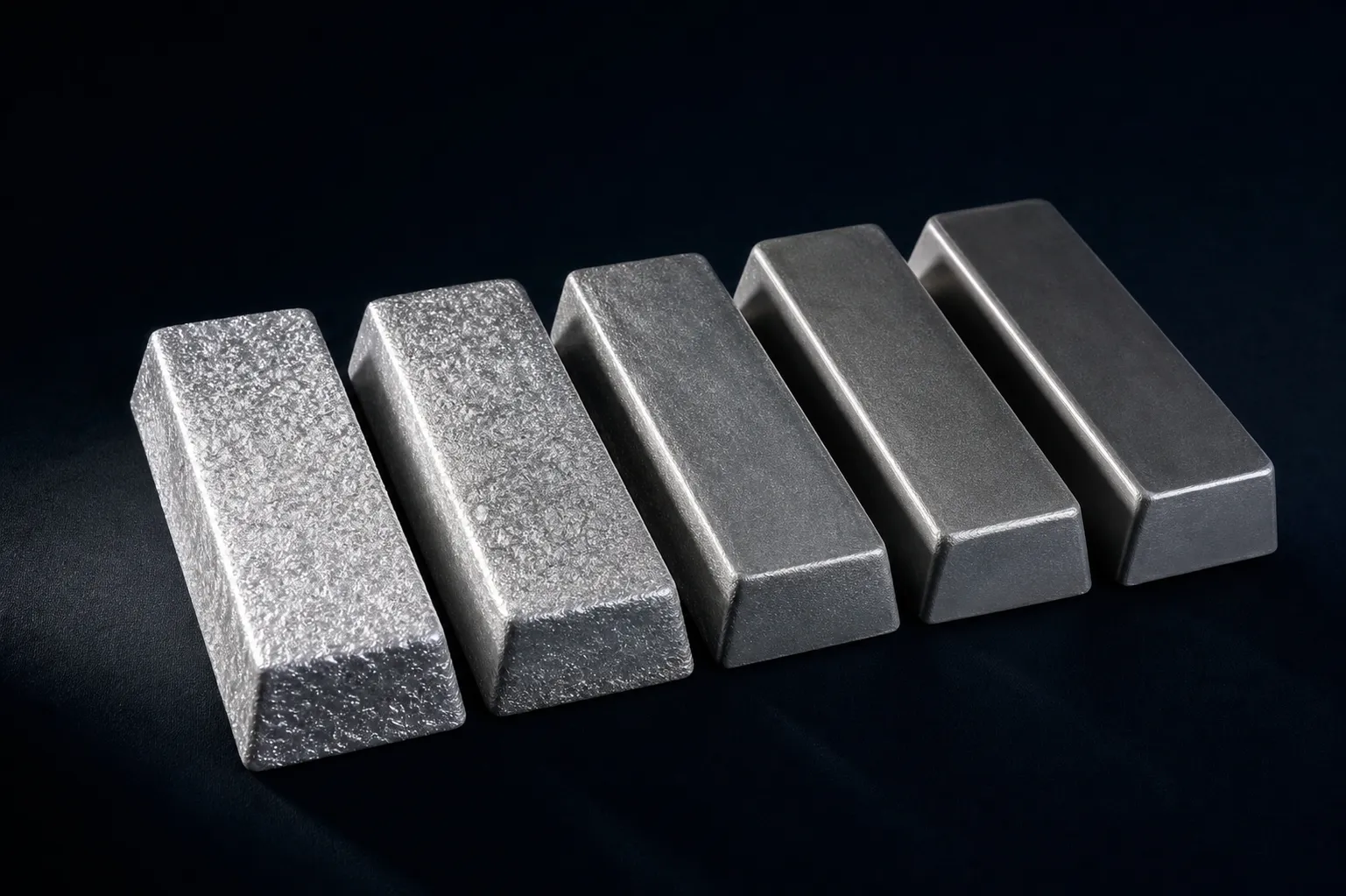
Two suppliers quote you ADC12. Both certificates say EN AC-46000. Both list silicon inside 9.6 to 12%, copper inside 1.5 to 3.5%, iron under 1.3%. On paper you are looking at the same alloy at two different prices, and the cheaper one wins.
Then one of them casts differently, and the reason is sitting in the elements the certificate does not report.
Where secondary ADC12 comes from
Most of the world's ADC12 is secondary, meaning it is blended from recycled aluminium: process scrap, end-of-life castings, extrusion offcuts, shredded automotive material. A refiner melts the mix, measures it, and adds silicon, copper and other elements until the specified elements land inside the EN AC-46000 window.
That is a legitimate process and it produces a legitimate alloy. Recycled aluminium also carries a fraction of the embodied energy of primary metal, which is a real environmental argument in its favour.
The catch is what the process controls for. A refiner is adjusting the elements the specification names. The elements it does not name go wherever the scrap stream takes them.
The elements nobody specifies
EN AC-46000 sets limits on silicon, iron, copper, manganese, magnesium, nickel, zinc, tin, lead and titanium. A standard certificate reports those and stops. Meanwhile the scrap stream can contribute chromium, vanadium, strontium, calcium, sodium, antimony and phosphorus, in quantities that are small enough to ignore individually and not always small enough to ignore together.
| Element | Typical source | Effect at trace level |
|---|---|---|
| Calcium, sodium | Fluxing residue, scrap contamination | Increases hydrogen pickup and porosity; degrades surface finish |
| Phosphorus | Mixed scrap streams | Interferes with strontium modification, coarsens silicon structure |
| Chromium, vanadium | Aerospace and automotive alloy scrap | Forms hard intermetallic sludge phases, accelerates tool wear |
| Antimony, strontium | Previously modified castings in the scrap mix | Uncontrolled modification; the two counteract each other |
Sludge, and why iron alone does not explain it
The failure mode most foundries recognise is sludge: hard, heavy intermetallic particles that settle in the holding furnace, block filters, wear the shot sleeve and appear as hard spots that ruin a cutting edge during machining.
Sludge is normally blamed on iron, and iron is part of it. The fuller picture is the sludge factor, an industry rule of thumb that weights iron against manganese and chromium:
Sludge factor = (1 × %Fe) + (2 × %Mn) + (3 × %Cr)
Chromium carries three times the weight of iron. A melt that looks comfortable on iron can still sludge if the chromium rode in on the scrap and nobody measured it, because chromium is not a reported element under EN AC-46000. Most die-casters aim to keep the factor below about 1.8 at normal holding temperatures.
What primary-based ADC12 changes
Building ADC12 on primary aluminium and adding controlled silicon and copper starts the alloy from a known composition instead of an averaged one. The specified elements land in the same place. The unspecified ones stay near zero, because they were never introduced.
In practice a foundry running primary-based ADC12 tends to see steadier hydrogen levels and less porosity variation between heats, less furnace sludge and longer intervals between cleanouts, more predictable machining, and heat-to-heat consistency that holds across a long production run rather than drifting with whatever the refiner's scrap intake looked like that month.
Which one should you buy?
Secondary ADC12 is the right economic answer for a great deal of work. Non-critical housings, thick-section parts, anything with a generous process window and a tolerant machining operation. Paying a primary premium there buys you nothing.
The calculation changes when your process window is narrow. Thin walls, pressure-tight castings, tight surface finish requirements, or a part where a machining reject costs considerably more than the metal in it. There, the variation is the expensive part, and consistency is what you are buying.
What to ask a supplier
Whichever route you take, three questions separate a supplier who controls their process from one who meets a specification on paper:
- Will you report elements outside the EN AC-46000 list? Chromium, vanadium and calcium in particular. A supplier who measures them can tell you; one who does not, cannot.
- What is your typical sludge factor, and how much does it move between heats? The spread matters more than the average.
- What iron band do you actually cast to? "Under 1.3%" is a specification limit, not an answer. A supplier targeting 0.8 to 1.1% for high-pressure die casting is managing die soldering deliberately.
Our ADC12 is built on primary metal with controlled residuals, cast to a 0.8 to 1.1% iron target for high-pressure die casting, and certified to EN AC-46000 and JIS H 5302 on one material test certificate. See the full specification.