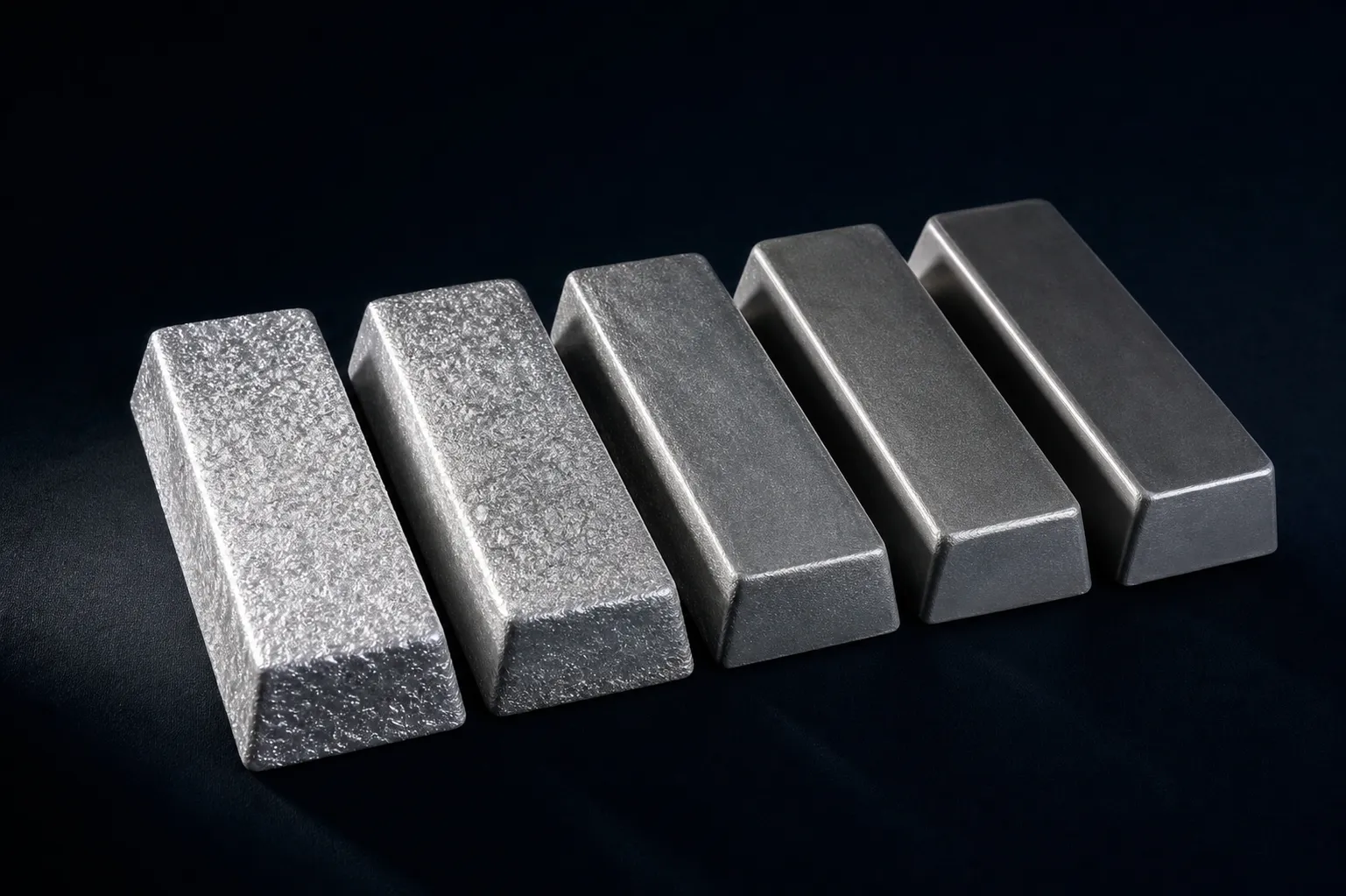
In high-precision B2B metallurgy, selecting the correct primary aluminium ingot grade is the foundational decision that dictates downstream casting quality, electrical conductivity, and mechanical performance. While many procurement departments view primary aluminium simply as a commodity, design engineers and foundry metallurgists understand that subtle variations in element concentrations have deep impacts on production yield and scrap rates.
Standard Purity Thresholds: Understanding A7 & P1020A
The global standard for primary commercial aluminium is dominated by the A7 grade (under Russian GOST 11069) and its direct equivalents P1020A (under LME specifications) and Al99.7 (under European EN 576 standards). All of these standards require a minimum pure aluminium content of 99.70%.
However, the critical metallurgical detail is not the 99.70% minimum purity, but the specific distribution of the remaining 0.30% maximum impurities. Silicon (Si) and Iron (Fe) are the primary impurities that must be carefully managed.
| Element | Standard A7 / P1020A Max (%) | Tech Aluminum Premium Tolerances (%) | Metallurgical Influence |
|---|---|---|---|
| Aluminium (Al) | 99.70 Min | 99.72 - 99.78 | Base mechanical strength and electrical capacity. |
| Iron (Fe) | 0.25 Max | 0.14 - 0.18 | Limits die-soldering in casting, but excess causes brittle intermetallic phases. |
| Silicon (Si) | 0.20 Max | 0.08 - 0.12 | Governs fluidity and thermal shrinkage, balanced against iron content. |
| Copper (Cu) | 0.03 Max | 0.005 Max | Extremely restricted to prevent corrosion susceptibility. |
| Zinc (Zn) | 0.03 Max | 0.015 Max | Kept low to prevent hot-cracking during extrusion remelting. |
| Gallium (Ga) | 0.03 Max | 0.015 Max | Maintained low to optimize high-temperature structural life. |
Why Low Iron is Crucial for Advanced Applications
For automotive foundries and wire-rod producers, the iron content within the primary ingot is the single most critical quality variable. When primary metal is remelted to produce structural casting alloys (such as AlSi7Mg), high iron levels lead to the formation of coarse, needle-like beta-phase intermetallics (Al₅FeSi). These needle structures act as severe stress concentrators, dramatically reducing the alloy’s elongation (ductility) and fatigue life.
"By restricting our standard primary ingot iron levels to less than 0.16% (well below the LME limit of 0.25%), Tech Aluminum guarantees that European Tier-1 casting components achieve outstanding fatigue resistance, especially in EV battery boxes and chassis nodes."
Remelting Efficiency & Ingot Practices
To achieve optimal chemical yields in your casting furnaces, Tech Aluminum recommends the following industrial remelting practices:
- Thermal Gradient Control: Maintain furnace melt temperatures between 720°C and 750°C to minimize dross formation and metal burning.
- Melt Degassing: Utilize rotary argon degassers rather than chlorine tablets to lower dissolved hydrogen content to ≤ 0.12 ml / 100g Al.
- Ingot Preheating: Always preheat ingot bundles to 150°C before introducing them to the molten bath. This completely eliminates any surface moisture, avoiding severe hydrogen pick-up and safety hazards.
Summary: Strategic Sourcing
Securing primary aluminium that consistently sits at the higher end of purity tolerances allows B2B manufacturers to tightly control their casting chemistry. Tech Aluminum's primary smelting facilities in Egypt deliver this premium metallurgical consistency directly to European ports, backed by complete certified OES test reports with every single shipment bundle.