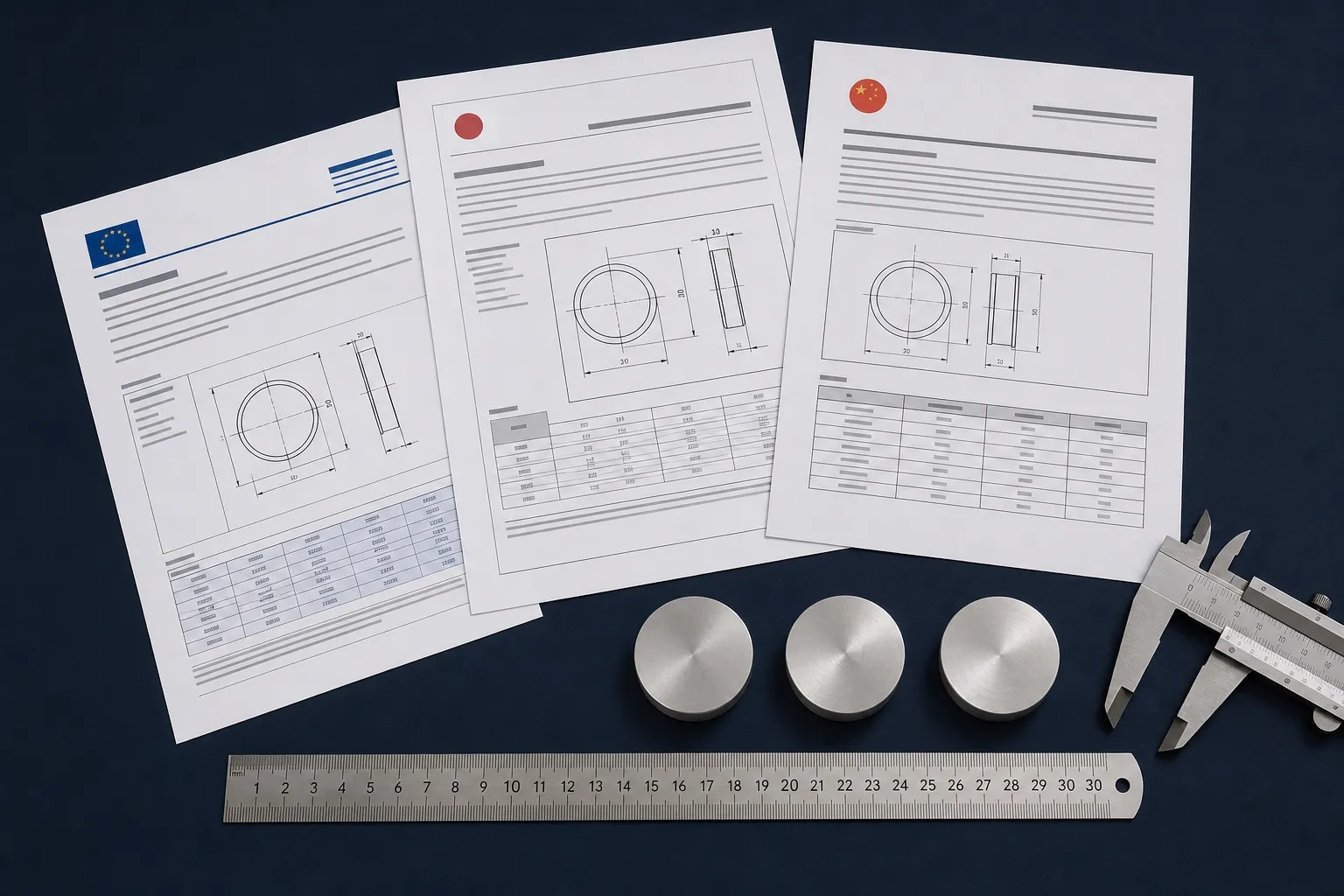
For design engineers and B2B procurement managers sourcing globally, translating metallurgical standard designations is a constant challenge. Sourcing an ingot under one regional standard to fulfill a specification written in another requires a granular, element-by-element chemical comparison. A small discrepancy in iron limits or zinc thresholds can alter alloy mechanical properties, resulting in casting rejects or structural failures.
Primary Standards Framework: The Three Giants
In global industrial procurement, three primary standard frameworks dictate B2B aluminium alloy trade:
- European Standards (EN): Managed by CEN, focusing heavily on chemical limits and material numbers (e.g., EN AC-46000).
- Japanese Industrial Standards (JIS): Widely specified in automotive applications globally (e.g., JIS H 5302 ADC12).
- Chinese National Standards (GB/T): Used heavily in Asian raw feedstock production (e.g., GB/T 15115 YL113).
The Case of Die-Casting Mainstream: EN AC-46000 vs. JIS ADC12
The Al-Si-Cu alloy family represents the most widely used casting feedstock on earth, crucial for automotive engine brackets, gearbox housings, and power-tool structures. While many databases label EN AC-46000, JIS ADC12, and GB/T YL113 as identical, a closer chemical inspection reveals critical metallurgical details.
| Element | EN AC-46000 (%) | JIS ADC12 (%) | Chinese GB/T YL113 (%) |
|---|---|---|---|
| Silicon (Si) | 8.0 - 11.0 | 9.6 - 12.0 | 9.6 - 12.0 |
| Copper (Cu) | 2.0 - 4.0 | 1.5 - 3.5 | 1.5 - 3.5 |
| Iron (Fe) | 1.30 Max | 1.30 Max | 1.30 Max |
| Magnesium (Mg) | 0.15 - 0.55 | 0.30 Max | 0.30 Max |
| Manganese (Mn) | 0.55 Max | 0.50 Max | 0.50 Max |
| Zinc (Zn) | 1.20 Max | 1.00 Max | 1.00 Max |
| Nickel (Ni) | 0.55 Max | 0.50 Max | 0.50 Max |
Key Metallurgical Implications of Differences
Understanding these compositional boundaries is crucial for optimal casting execution:
- Silicon Control & Fluidity: JIS ADC12 specifies a higher bottom limit of silicon (9.6%) compared to EN AC-46000 (8.0%). Higher silicon content increases molten metal fluidity, allowing the alloy to easily fill thin-walled die cavities in complex automotive components.
- Magnesium limits: EN AC-46000 specifies a strict range of 0.15% to 0.55% magnesium, whereas Japanese ADC12 only sets a 0.30% maximum limit. Magnesium combines with silicon to form Mg₂Si, which undergoes precipitation hardening. Foundry operators must monitor magnesium levels to prevent excessive brittleness.
- Iron & Die-Soldering: All three standards allow up to 1.30% iron. In high-pressure die casting, a minimum of 0.6% iron is intentionally required to prevent the molten alloy from welding to the steel die faces (die-soldering).
"At Tech Aluminum, we cast our alloy ingots with custom narrow-range windows that satisfy both EN AC-46000 and JIS ADC12 simultaneously, simplifying stock management for multi-national B2B foundries."
Summary: Strategic Procurement
Never assume regional alloy codes are perfect, one-to-one drops. By checking spectrographic tolerances and demanding EN 10204 3.1 certification, procurement managers ensure perfect standards compliance across global production locations.